Why Students Forget – 3 Research-Based Strategies That Make Learning Last
We’ve all had that moment—students ace the quiz on Friday, but by Monday, it’s like they’ve never seen the material before. You’re not alone! Learning that lasts doesn’t just depend on how well we teach—it depends on how well students’ brains encode and retrieve information.
That’s where three powerful, research-backed strategies come in: retrieval practice, spacing, and interleaving. When we use these intentionally, students remember more, forget less, and can actually apply what they’ve learned—from decoding words to mapping the Oregon Trail.
Understanding “Encoding” in Learning and Memory
Before diving into these strategies, it helps to understand a key term: encoding.
In cognitive science, encoding refers to how the brain takes in new information and transforms it into a memory that can be stored and recalled later. In other words, encoding is how experience becomes knowledge.
It’s easy to confuse this with how early literacy teachers use the word “encoding” (as in spelling a word by matching sounds to letters). But in the context of memory, encoding means something broader—it’s the brain’s process of organizing and connecting new information to what we already know.
When students connect new content to prior learning, pay attention to meaning, and practice recalling information, they’re improving how their brains encode information. Retrieval, spacing, and interleaving all work because they strengthen that initial encoding and make recall easier later.
Retrieval Practice: Remembering by Bringing It Back
Retrieval practice is simple but powerful: instead of reviewing by re-reading notes or slides, students pull information from memory. That mental effort strengthens learning and builds long-term retention.
Agarwal and Bain (2019) call retrieval practice “powerful teaching” because every time students retrieve, the memory trace becomes stronger. Even short, low-stakes quizzes, whiteboard reviews, or “brain dumps” (where students write everything they remember before checking notes) help solidify learning.
In action:
- In phonics, ask students to recall yesterday’s words containing the digraph sh before reading new ones. This reinforces orthographic mapping—the process that helps students store sound-letter patterns for automatic word recognition.
- In social studies, try an end-of-class “retrieval relay” where groups list key points about the causes of the American Revolution—no notes allowed.
- In science, have students sketch or label a process (like photosynthesis) from memory before looking at the model again.
Why it works:
Retrieval strengthens connections in the brain between information and context, improving students’ ability to apply what they know later (Sana & Yan, 2021).
Spacing: Let Time Do Its Work
We often feel the pressure to move quickly, but learning benefits when we slow down. Spacing means spreading review opportunities over time instead of teaching a concept once and leaving it behind. The idea dates back to Ebbinghaus’s (1885) research on memory, which showed that we forget rapidly unless learning is reinforced.
In action:
- In reading, revisit word patterns or spelling rules days later. For instance, if first graders learned ai and ay last week, bring them back into a word sort or reading passage this week. That extra “time gap” deepens orthographic mapping.
- In geography, quiz states and capitals not once but several times over the semester, mixing old with new.
- In secondary history, return to key themes from early units when studying new eras (“How does the Civil Rights Movement connect to Reconstruction?”).
Spacing allows a bit of forgetting to happen, which makes later retrieval effortful—and that effort cements learning (Bjork, 1994).
Interleaving: Mixing It Up for Stronger Thinking
When students practice the same type of problem or concept over and over, they often rely on pattern recognition rather than deep understanding. Interleaving means mixing different but related topics or skills so students have to think more flexibly.
In action:
- In phonics, mix digraphs and vowel teams instead of focusing on one per lesson. Students must decide whether “beach” or “reach” fits an ea or ee pattern—boosting discrimination and retrieval.
- In math, blend problem types (addition, subtraction, and multiplication) instead of blocking them by unit.
- In geography, mix physical and political map questions in the same review.
- In literacy, interleave comprehension strategies—students might identify the main idea in one paragraph, summarize in the next, and infer in the third.
Students often feel less confident during interleaved practice because it’s harder—but they remember more later (Sana & Yan, 2021).
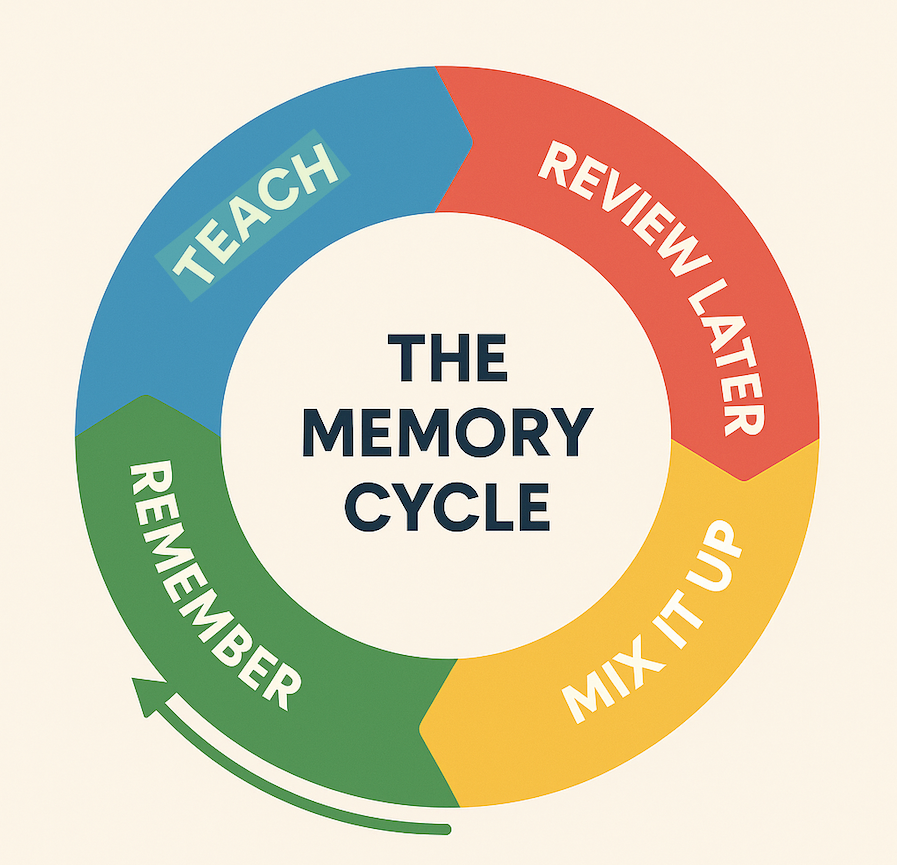
“The Memory Cycle” infographic designed by Dr. Angelia Greiner for The Lesson Crafter.
© 2025 The Lesson Crafter
Making It Work in Real Classrooms
Retrieval, spacing, and interleaving don’t require a curriculum overhaul. Small shifts make a big difference:
- Warm-up retrieval: Start class with a “What do you remember from last week?” question.
- Cumulative exit tickets: End class with one question from today’s lesson and one from two weeks ago.
- Interleaved review days: Mix topics (e.g., vocabulary + grammar + reading strategy).
- Spiral notebooks: Keep a section where students revisit key concepts weekly.
- Visual retrieval: Ask students to draw, map, or categorize from memory instead of rereading.
When teachers blend these practices into everyday instruction, students stop treating learning as “study and forget” and start building durable knowledge that truly sticks.
Final Thoughts
Helping students remember what they learn doesn’t mean adding more work—it means teaching in ways that align with how memory actually works. Retrieval, spacing, and interleaving create those “desirable difficulties” that may feel challenging in the moment but lead to lasting learning.
Whether you’re teaching kindergartners their first phonics patterns or high schoolers about global geography, these strategies work across grades and subjects. Each time students retrieve, space, and mix what they learn, they’re not just recalling facts—they’re reshaping their brains to remember for the long term.
Works Cited (APA 7th Edition)
Agarwal, P. K., & Bain, P. M. (2019). Powerful teaching: Unleash the science of learning. Jossey-Bass.
Bjork, R. A. (1994). Memory and metamemory considerations in the training of human beings. In J. Metcalfe & A. Shimamura (Eds.), Metacognition: Knowing about knowing (pp. 185–205). MIT Press.
Ebbinghaus, H. (1885). Memory: A contribution to experimental psychology. (H. A. Ruger & C. E. Bussenius, Trans.). Dover Publications, 1964.
Sana, F., & Yan, V. X. (2021). Interleaving and spacing in learning: What teachers should know. Educational Psychology Review, 33, 1739–1761. https://doi.org/10.1007/s10648-021-09601-1